

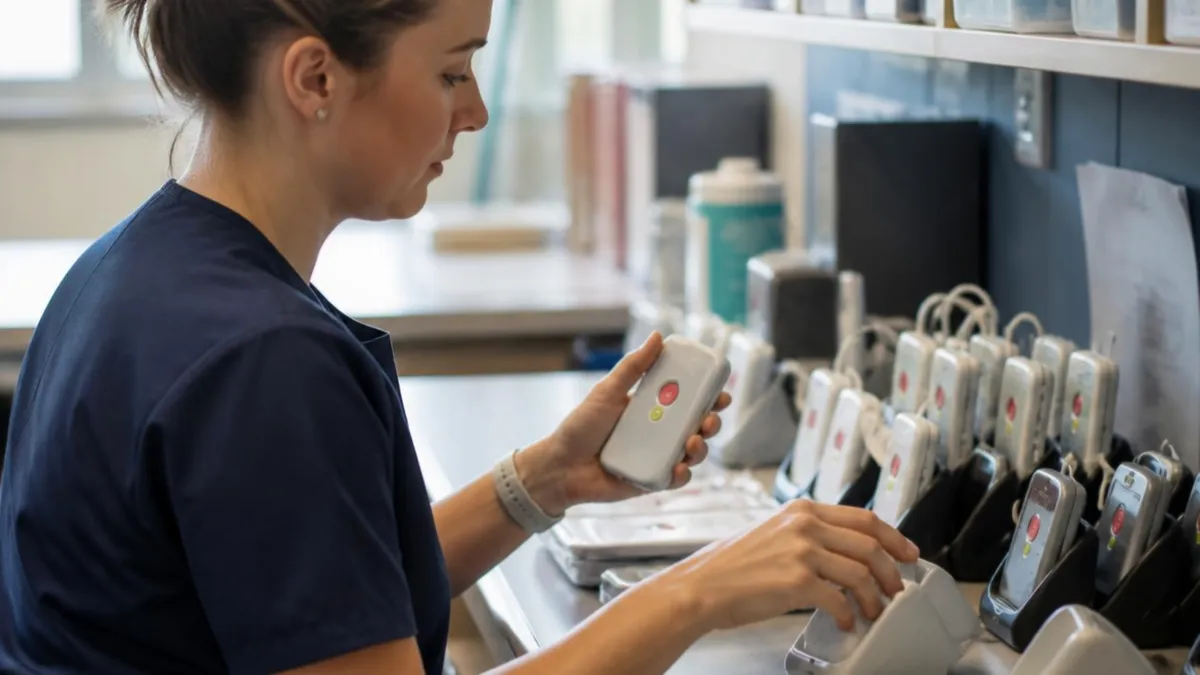
Every nurse call vendor demo looks impressive. Sleek dashboards, fast response times, glowing testimonials from other communities. What they rarely show you is what happens six months after go-live, when your staff is elbow-deep in the daily reality of keeping the system running.
That’s where most technology decisions for senior living operators quietly go wrong. The demo sells the software. Nobody sells you the labor.
The Blind Spot in Most Evaluations
When operators compare nurse call systems, the comparison usually comes down to purchase price, monthly licensing, and maybe installation cost. Reasonable enough – those are the numbers vendors put in front of you, and they’re the easiest to compare side by side.
But a nurse call system doesn’t run itself. Someone has to charge or replace pendant batteries. Someone has to clean devices. Someone chases down false alarms, reassigns devices when residents transfer or discharge, and handles the inevitable firmware update that takes a device offline mid-shift. None of that shows up on a quote. All of it shows up in your staff’s day – and on your labor budget, whether you’re tracking it or not.
Two systems with nearly identical sticker prices can carry very different ongoing labor burdens depending on their design. A wireless pendant-based system might have a lower upfront cost but a real recurring charging and battery-replacement cycle. A hardwired system avoids that cycle entirely but may carry higher maintenance costs elsewhere. Neither is automatically the better choice – but you can’t know which one is right for your community if you’re only comparing the numbers vendors chose to show you.
Why This Gets Missed
It’s not that vendors are hiding anything maliciously. Their job is to sell a system, and staff labor isn’t their cost to bear – it’s yours. There’s no incentive for them to volunteer it, and most operators don’t know to ask, because the question doesn’t naturally surface during a product demo.
The result: operators make six-figure technology decisions based on partial information, then discover the real cost of ownership one battery cart and one overwhelmed charge nurse at a time.
Counting What Actually Counts
A proper cost evaluation for nurse call – or really any resident-facing technology – has to include what I call the labor side of total cost of ownership: the recurring time staff spend keeping the system functional, not just the time it saves them in emergencies. Battery cycles, charging routines, troubleshooting, reassignment during admissions and discharges – all of it has a frequency, a duration, and a staff role attached to it, and all of it belongs in the decision.
This is a structured part of how I run technology evaluations for operators – built specifically to surface these costs before contract signature, not after. It’s one of the reasons operators bring in a fee-for-service, vendor-neutral consultant in the first place: someone whose job is to see the full picture, not to close the sale.
If you’re currently evaluating nurse call vendors, it’s worth pausing before you sign to ask: has anyone accounted for what this system will actually cost my staff’s time? If the answer is no, that gap is worth closing before the contract – not after.